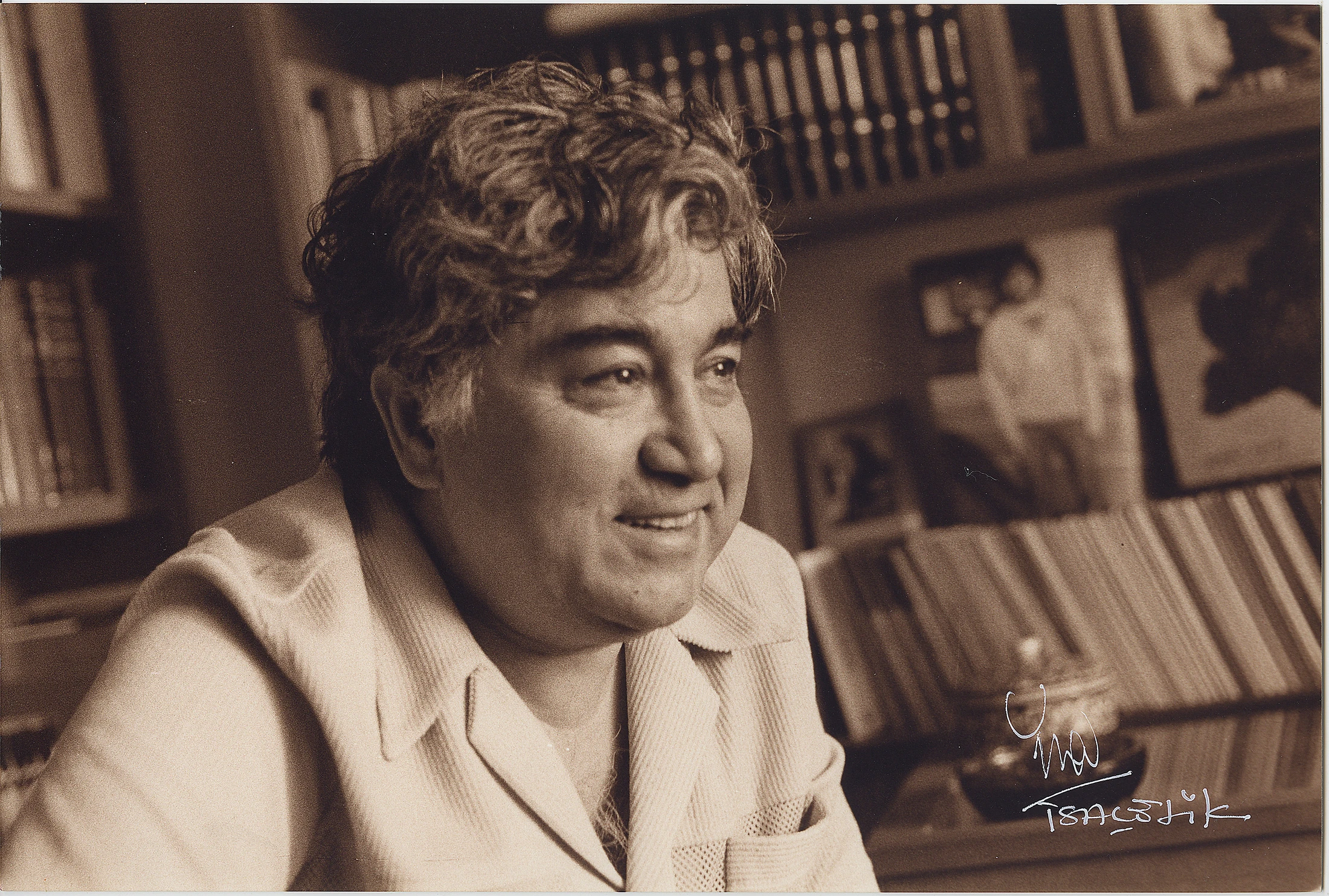
AZİZ NESİN
(20 December 1915, Heybeliada, İstanbul ● 6 July 1995, Çeşme, İzmir)
He stands at the pinnacle of Turkish humorous literature. An actively engaged intellectual, he confronted the problems of his age. With great skill he portrayed the distortions and contradictions of the social order and became a world-class representative of modern Turkish humour. His original name was Mehmet Nusret.
After studying for two years at Darüşşafaka in İstanbul, he graduated from Kuleli Military High School in 1935, the Military Academy in 1937 and the Military Technical School in 1939. While a first lieutenant, he was dismissed from the army in 1944 on a charge of “abuse of duty and authority”. After running a grocery shop for a time, he began working in journalism in 1945. He worked for Yedigün, Karagöz and Tan and published a magazine called Cumartesi. In 1946 he began publishing the satirical newspaper Markopaşa with Sabahattin Ali. In 1947, his unpublished pamphlet Nereye Gidiyoruz?, which criticised American aid to Türkiye under the Truman Doctrine, brought a sentence of ten months’ imprisonment and three months and ten days under police supervision in Bursa. He was arrested again over Azizname, published the following year, and acquitted after four months in detention. In 1950, for having part of the preface to G. Politzer’s Marksist Felsefe Dersleri translated and published in Yeni Baştan, he was sentenced to one year and four months in prison and police supervision in İstanbul during his sentence. After his release, he opened a bookshop and later a photography studio. In 1954 he began writing humorous stories under pseudonyms for Akbaba. Over his literary career he used more than a hundred pen names. Following the events of 6–7 September 1955, when non-Muslims’ homes and shops in İstanbul were looted, he was arrested with other left-wing friends. He was released six months later. Winning first prize, the Golden Palm, for Kazan Töreni at the international humour competition in Bordighera, Italy, in 1956 marked a turning point in his life. He began publishing under his own name. In 1957 he founded Düşün Publishing with Kemal Tahir. He took sole charge of the publishing house in 1958 and continued until 1969. He wrote daily columns for Yeni Gazete, Akşam, Tanin, Öncü, Yeni Tanin and Günaydın, for which he also prepared the weekly humour supplement Ustura. In 1961 he spent four months in detention over an article.
In 1972 he established the Nesin Foundation in Çatalca to educate children without families and donated all income from his books to it. Between 1976 and 1985 he published Nesin Vakfı Edebiyat Yıllığı, an annual selection and assessment of the year’s literature. In 1975 he was elected president of the Writers’ Union of Türkiye, a position he held until 1989. In 1984 he led preparations for the Intellectuals’ Petition opposing military rule. He was tried and acquitted. In later years he devoted more time to social activism. In 1993 he began writing columns for Aydınlık. His announcement that he would publish Salman Rushdie’s The Satanic Verses (1988) in Turkish provoked fierce criticism from Islamist circles. On 2 July 1993, during the Pir Sultan Abdal Festival in Sivas, he survived the Madımak Hotel fire, started by a crowd demanding sharia, in which 37 people lost their lives.
His works offer a broad picture of Turkish society and draw on the narrative elements of folk literature. At times he used fairy-tale themes to portray everyday events and social failings through criticism and satire. Drawing also on the expressive possibilities of the meddah storytelling tradition, he developed a modern form of humorous short story. He chose his subjects from everyday life. While voicing the concerns of broad sections of society, he also portrayed with skill the individual’s place in a changing social world.
Alongside humorous writing, Aziz Nesin produced poetry, plays, essays, studies, memoirs and newspaper columns. Through the many social initiatives he founded or joined, he also became one of his country’s foremost intellectual figures.
Source: Nesin Publishing